Needle Loom Technology Overview | High-Efficiency Textile Machines, Short Lead Times - Kyang Yhe (KY)

Needle loom photo showing the production process of narrow fabrics. | Durable Textile Machinery for Zipper, Label, Webbing - Kyang Yhe (KY)

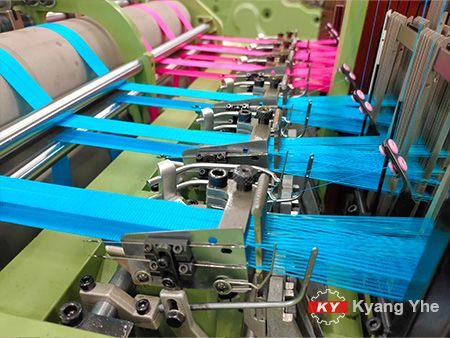
Needle loom photo showing the production process of narrow fabrics.

Needle Loom Technology White Paper

Needle Loom Technology Overview

Needle Loom Technology Overview introduces definitions, principles, applications, and industry trends, guiding engineers and decision-makers. A needle loom is a shuttleless weaving machine that efficiently produces narrow fabrics such as elastic bands, shoelaces, seat belts, and industrial webbings. Compared to shuttle looms, it offers compact design, higher speed, and lower maintenance; compared to jacquard looms, it suits functional fabric mass production. With smart manufacturing and sustainability, needle looms advance toward electronic warp let-off, data collection, and MES/ERP integration.

What is a Needle Loom? (Principles and Applications)

A needle loom is a shuttleless weaving machine specifically designed for producing narrow fabrics, commonly used for seat belts, shoelaces, elastic bands, industrial slings, and various decorative tapes. Unlike traditional shuttle looms, the needle loom inserts the weft yarn through a “weft needle,” replacing the heavy shuttle movement. This design results in a more compact structure that maintains stable operation at high speeds, making it suitable for long-term continuous production of narrow fabrics. Its advantages include high efficiency, low maintenance requirements, and consistent fabric quality, which is why it is widely applied in the manufacturing of functional and industrial webbings.


Applications

CategoryExamples
Elastic & Non-elastic tapesUnderwear, sportswear, medical bandages
Consumer ribbonsShoelaces, grosgrain, satin ribbons
Home textilesSofa belts, mattress tapes, curtain headings
Industrial webbingsRatchet straps, lifting slings, safety harnesses, seat belts

Comparison with Other Looms

Needle looms are often compared with other weaving machines. Compared to traditional shuttle looms, they provide higher productivity and lower maintenance costs in the production of narrow fabrics. In contrast to jacquard looms, they are more suitable for mass production of functional webbings rather than complex decorative patterns. These differences highlight the positioning of needle looms in both industrial and everyday applications.
  • vs. Shuttle looms: Higher efficiency and lower maintenance.
  • vs. Jacquard looms: Better for functional narrow fabrics than complex patterns.

Comparison of the Applications and Efficiency of Different Looms

Needle, shuttle, and jacquard looms comparison
Item

narrow fabric needle loom

Needle Loom

shuttle loom

Shuttle Loom

jacquard loom

Jacquard Loom

ApplicationNarrow fabrics: seat belts, shoelacesWide fabrics (general textiles)Decorative patterns, branding
Weft InsertionWeft needle (shuttleless)Shuttle movementElectronic/mechanical jacquard control
ProductivityHigh (1800–2500 rpm)Medium (800–1200 rpm)Low–Medium (pattern dependent)
MaintenanceLow, lightweight partsHigh, frequent shuttle wearMedium–High, requires setup
Best Suited ForFunctional narrow webbingsGeneral fabric weavingComplex patterns, decorative textiles

Core Needle Loom Types and Differences

Flat-head Needle Loom vs Angled-head Needle Loom

Exterior view of a flat-head needle loom
Flat-head Needle Loom
  • Best for: Wide webbings (≥ 50 mm), e.g., automotive seat belts and industrial slings
  • Characteristics: Straight beat-up layout, short tension path, minimal width deviation
  • Advantages: High tension stability; suitable for long, continuous production
Wide-width High stability Industrial
Exterior view of an angled-head needle loom
Angled-head Needle Loom
  • Best for: Narrow tapes (5–30 mm), shoelaces, elastics, decorative ribbons
  • Characteristics: Shed angle configuration enables multi-tape weaving
  • Advantages: More tapes per run; about 20–30% higher throughput than flat-head models
Multi-tape High throughput Apparel

Jacquard Needle Loom vs Plain Needle Loom

Jacquard needle loom in operation
Jacquard Needle Loom
  • Best for: Brand identification, complex patterns, decorative webbings
  • Characteristics: Precise individual warp control for high-detail motifs
  • Note: More complex setup and maintenance; moderate production efficiency
Complex patterns Branding Customization
Plain needle loom in operation
Plain Needle Loom
Plain Needle Loom
  • Best for: Functional webbings such as military straps and seat belts
  • Characteristics: Simple construction and stable tension; ideal for long runs
  • Advantages: High efficiency, easy maintenance, maximized output
High efficiency Stability Functional webbing

Key Factors for Machine Selection

1. Width and Thickness

Industrial slings (6–8 mm thick, >150 mm wide) require heavy-duty machines; shoelaces (5–10 mm wide) are best suited for multi-tape angled looms.

2. Material and Structure

  • Elastic materials like spandex or nylon require precise warp let-off, while polyester or cotton focus on uniform pick density.

3. Application and Capacity

For large-scale production of industrial slings, heavy-duty models are recommended; for decorative ribbons or elastic bands used in garments, high-speed multi-tape machines are more suitable.

  • Seat belts: Require long-term continuous production → High-speed flat-head loom.
  • Decorative ribbons: Require patterns and brand identification → Jacquard loom.

※ Capacity formula:

Speed (rpm) ÷ Weft density (pick/cm) × Meters per hour × Number of tapes × 0.85 loss factor = Estimated output for non-elastic webbings


Maintenance and Consumables

Common consumables include weft needles, guides, reeds, and belts. When a weft needle wears beyond 0.1 mm, defect rates increase significantly. Regular checks every 500–800 operating hours are recommended.


❓FAQ

What is the difference between a needle loom and a needle-punch machine?
A needle loom is a weaving machine for interlacing warp and weft yarns, while a needle-punch machine produces nonwoven fabrics.
How much webbing can a needle loom produce in one day?
Depending on width, density, speed, and number of tapes, daily output can range from several thousand to tens of thousands of meters.
How to choose between flat-head, angled-head, and jacquard needle looms?
Choice depends on width, thickness, material, and application.

References

  1. Kyang Yhe Delicate Machine Co., Ltd. (2025). Needle Loom Technology White Paper. Available at: https://www.kyangyhe.com/page/whitepaper/needle-loom-technology.html
  2. Fortune Business Insights. (2024). Textile Machinery Market Size, Share & Industry Growth Report. Available at: https://www.fortunebusinessinsights.com/textile-machinery-market-106046
  3. Precedence Research. (2024). Textile Processing Machinery Market Size to Hit USD 53.54 Bn by 2034. Available at: https://www.precedenceresearch.com/textile-processing-machinery-market
  4. Deng, H. & Zhang, L. (2011). Study on the Needle Loom Condition Monitoring System Based on Working Condition Parameters. Advanced Materials Research, 219–220, 709–714. doi:10.4028/www.scientific.net/AMR.219-220.709
  5. Hearle, J.W.S. (1973). A Study of Needle Action During Nonwoven Fabric Formation. Journal of the Textile Institute, 64(5), 255–263. https://doi.org/10.1080/00405007308630310

Needle Loom Technology White Paper | Factory-Direct Textile Machinery, OEM/ODM Support - Kyang Yhe (KY)

Kyang Yhe (KY), founded in 1964 in Taiwan, manufactures high-quality textile machinery. We specialize in narrow fabric jacquard looms, high-speed needle looms, heavy-duty weaving, braiding, and crochet machines. Get OEM/ODM customization, fast quotations, short lead times, and global service.

Our industrial machines run fast and stable, with easy maintenance. Applications include elastic and ribbon tapes, safety belts, luggage belts, and hook-and-loop. The lineup covers needle looms, narrow fabric weaving machines, label printing machines, and more—built for efficient, consistent production.

With 60+ years of experience, KY provides installation, training, spare parts, and after-sales support. Talk to our engineers today—request a free consultation or quote to choose the right machine for your line.